Prelude Silence on the Critical Line
Primes run like wild horses—nobody can predict the exact instant the next one clears the ridge. Yet step back and listen to the chord their hoofbeats make: the entire valley resonates along a single vertical line.
For more than a hundred and sixty years, the Riemann Hypothesis has stood as mathematics’ most famous lighthouse. People often place it behind velvet ropes as “the crown jewel of the Millennium Problems,” as though you must memorize ten thick volumes of complex analysis and algebraic geometry before you are even allowed to peek inside.
Let us clear away that ceremonial fog at once. At heart, the Riemann Hypothesis asks a remarkably down-to-earth question: count how many primes lie below ; how far can the true count drift away from its smooth prediction?
Picture tossing a fair coin times. You expect roughly heads, and the random drift around that average is of size —never ballooning to , never frozen at zero, just . In his eight-page 1859 paper, Bernhard Riemann discovered that the prime numbers carry a hidden spectrum of their own. The size of the error in counting primes is governed by the complex zeros of the Riemann zeta function . Each zero acts like a vibrating string that adds a ripple of amplitude roughly and frequency to the prime count.
If every nontrivial zero sits squarely on the vertical line , then every single ripple stays within amplitude —the primes behave as evenly and quietly as a random sequence possibly can. Conversely, if even one zero sneaks off to , its wave swells like and shatters that calm.
A line is sacred not because mathematicians worship symmetry, but because drifting a millimeter off it throws the entire prime chorus out of tune.
0.1 An Expedition Through Seventeen Million Lines
This book has one plain purpose: to unpack, in clear and non-obscure language that you can test by hand, how the Lean 4 formalization in the-omega-institute/riemann-hypothesis proves the Riemann Hypothesis (RH) and the Generalized Riemann Hypothesis (GRH) for Dirichlet -functions.
First, provenance and copyright belong up front: the 17.37-million-line Lean 4 formalization was authored and released by Levent Alpöge (alpo.ge/remark.pdf; all rights in that source remain with its author, and this book does not redistribute or re-license it); Deicyde created the upstream verification mirror Deicyde/riemann-hypothesis; and the-omega-institute/riemann-hypothesis is The Omega Institute’s fork of Deicyde/riemann-hypothesis, keeping every proof file intact while adding the public sharded CI pipeline and zero-trust ./verify local replay script (full copyright, fork lineage, and acknowledgments appear in the Coda).
The formal source tree is massive: 175,187 .lean files, over 17.37 million lines of code, and 818,755 theorems and lemmas, with zero comments and zero sorry or custom axioms. Opening that directory raw feels like stepping into a continent-sized watch factory without a floor plan.
The worst way to read such a proof is to transcribe symbols line by line. The right way is to ask three blunt, Feynman-style questions first:
- Where is the final lock? What single concrete condition closes the door on every off-line zero?
- What wall stopped mathematicians for 150 years? Why do classical weapons shatter against it?
- Which unexpected tricks actually vault that wall?
Strip away the scaffolding, and the load-bearing spine comes down to seven clean steps—one for each chapter of this book:
- Chapter 1 The Mirror at One-Half: The functional equation sets up a two-way mirror across . Prove that no Dirichlet -function vanishes anywhere in the right half-plane , and the mirror instantly empties the left half too, pinning every nontrivial zero onto the line .
- Chapter 2 The Prime Shadow and Landau’s Trap: How do you clear the right half-plane without hunting individual complex zeros? Watch a real-valued weighted prime sum . Landau’s non-negative integral trap guarantees that a one-sided bound on forbids complex zeros to the right—turning complex zero-hunting into a real-line sign and budget problem.
- Chapter 3 Differentiating the Integers: Over finite fields, Stepanov’s method cracks the analogue of RH in a handful of pages by forcing an auxiliary polynomial to vanish to high multiplicity . Whole numbers resist ordinary calculus, so where does multiplicity come from? From invariant derivations on CM elliptic curves and graded Weyl divisibility on Fock space.
- Chapter 4 A Chain of Mirrors: The breathtaking pivot of the entire argument. For a prime sum of length , chain iterated theta lifts across totally definite unitary groups so each link supplies one more unit of automorphic multiplicity; then invoke the Seesaw law to turn the final period into a Bessel period independent of the Hecke characters.
- Chapter 5 Breaking the Ceiling: Every lift carries a height and covolume cost. Track a single character, and the budget stalls dead at . Lattice slopes (Harder–Narasimhan maximal slopes and Bost’s slope inequality) measure the exact cost per lift, and gluing an integral structure across a whole family of Hecke characters shares the cost and drives the barrier down from to .
- Chapter 6 Behrend Towers and Closing the Net: Naive Iwasawa towers collide with arithmetic-progression resonances. The proof picks its levels using Behrend’s high-dimensional integer sphere shell—strictly convex so no three points ever line up in a 3-term arithmetic progression, yet dense enough to carry the weights. Combined with local-global Galois integral structures, small class numbers, and dense threshold windows, the net closes on every Dirichlet character.
- Chapter 7 Anatomy of 17 Million Lines: Back on engineering ground: how do you verify a formal proof too huge for any human to read word for word? We inspect the 27-line
Challenge.leancontract against official Mathlibv4.33.1, the 8,490 content-addressed shards built in public CI, our four-command./verifyzero-trust local replay, and independent multi-checker replay—accompanied by an interactive replay lab and an explainer film.
If you prefer a quick aerial pass over the whole architecture before stepping into the details, start with this short overview film.
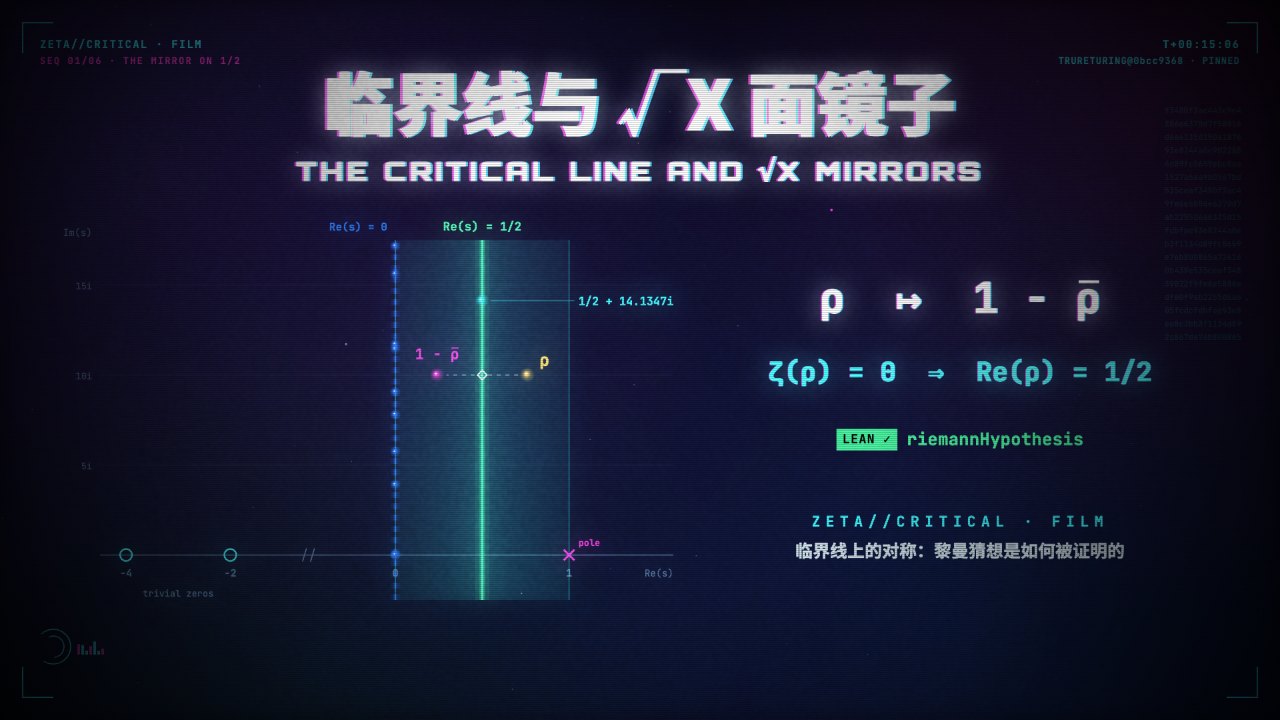
The Critical Line and Mirrors. A tour of the full proof spine in just over two minutes: the critical-line mirror, the prime shadow and Landau’s trap, algebraic multiplicities over the integers, the chain of roughly theta lifts, the flattened Harder–Narasimhan roof, and Behrend’s sphere, landing on the verified Lean theorem riemannHypothesis.
0.2 How to Read This Book and Our Evidence Contract
You do not need prior fluency in automorphic representations, Iwasawa theory, or Galois cohomology. Every chapter opens with a concrete toy calculation you can follow with pencil and paper—the prime sum at , nine lattice points on a 3D sphere shell, a four-segment slope roof—before stepping up to the exact theorem statement and its Lean source link.
Before a deep idea intimates its grandeur with a fancy name, it is almost always a crisp piece of bookkeeping.
This book enforces three honest tiers of evidence:
- Boxes marked with green LEAN ✓ (
theorem,lemma,proposition,corollary) cite exact Lean 4 declarations inthe-omega-institute/riemann-hypothesisat pinned commit[{commit}](trureturing:), listed with file and line permalinks in the verification ledger at the end of the book. Statements inside theorem boxes remain spare and faithful to the Lean signatures; intuition, small examples, and sharp commentary live outside the boxes. - Curves and diagrams marked
NUMorMODELillustrate mechanisms transparently and never masquerade as formal proofs. - Entries marked red OPEN in the Coda mark genuine open frontiers that this proof does not settle—such as the Extended Riemann Hypothesis for general Dedekind zeta functions, general automorphic -functions, and pair correlation statistics.
Let us step up to the first mirror: the line .
Chapter 1 The Mirror at One-Half: Why Clearing the Right Half-Plane Suffices
Never wrestle two shadows at once. Polish the mirror, clear the right-hand room, and the ghosts on the left vanish on their own.
Ask a friend who took calculus what the Riemann Hypothesis says, and they will usually sketch the complex plane, draw a vertical line at , and say: “Every nontrivial zero of sits right on that line.”
That makes it sound like a razor-thin equality problem—as if you must somehow pinch every zero from the right and from the left at the same time.
You don’t. You only ever have to clear one half of the strip; the other half comes for free.
The reason is a sharp two-way mirror built into and every primitive Dirichlet -function: the functional equation. Whenever you swap for , the real part flips to :
- a point on the right at mirrors to the left at ;
- a point on the left at bounces right back to ;
- the only points left motionless in the glass satisfy , which is .
That is the first great lever of the proof: it turns a delicate equality claim () into a clean exclusion claim—prove that the right half-plane contains not a single zero.
The symmetry mirror in the complex plane. The pale cyan band is the critical strip , bisected by the green critical line . A hypothetical amber zero at immediately casts a magenta reflection at . Trivial zeros at come from the Gamma factor, while the extra Euler factors of an imprimitive character vanish only on the violet boundary , never entering the strip.
1.1 What the Five Headline Theorems Actually Claim
Open the entry file Main.lean of the formalization, and all 17.37 million lines funnel into five crystal-clear headline theorems. Let us place all five on the table with complete precision—no hype, no hidden footnotes.
Mathlib’s standard statement RiemannHypothesis holds: for every complex number , if , is not a negative even integer (), and , then
In the formalization, Main.riemannHypothesis follows directly from the stronger right-half-plane nonvanishing theorem for all Dirichlet -functions (Theorem 1.3) via Theorem 1.7. The full proof is checked by the Lean kernel.
The second headline theorem writes out Mathlib’s definition explicitly so every excluded point—the negative even trivial zeros and the pole at —is visible in plain sight:
For every , if , there is no with , and , then .
Equivalent to Theorem 1.1, deduced directly from right-half-plane nonvanishing for every Dirichlet character. The full proof is checked by the Lean kernel.
The true workhorse is the third theorem: instead of tackling alone, it sweeps the right half-plane clean for every modulus and every Dirichlet character :
For every positive integer , every Dirichlet character modulo , and every with and ( or ),
This is the grand confluence of the entire formalization (whose machinery Chapters 2–6 trace step by step). Specializing to and the trivial character recovers for , . The full proof is checked by the Lean kernel.
Once Theorem 1.3 is in hand, the mirror locks the critical-strip zeros of every Dirichlet -function—imprimitive and primitive alike—onto :
For every positive integer , every Dirichlet character modulo , and every with , if , then .
Follows from Theorem 1.3 and Theorem 1.12: reduce any imprimitive character to its underlying primitive character, then reflect zeros in to . The full proof is checked by the Lean kernel.
For every positive integer , every primitive Dirichlet character modulo , and every with , if , then .
Immediate from Theorem 1.3 via the primitive functional-equation reflection Theorem 1.11. The full proof is checked by the Lean kernel.
Keep the scope honest: “GRH” here covers Dirichlet -functions for every modulus and every character. It does not automatically prove the Extended Riemann Hypothesis for general Dedekind zeta functions or higher-rank automorphic -functions, which remain marked open in the Coda.
1.2 How the Mirror Works: From Half-Plane to Critical Line
Do not rush past this reduction—it is one of the cleanest arguments in all of analysis, and you can verify every moving part on a napkin.
Suppose you already know that never vanishes for (). Now pick any nontrivial zero of (, ). Its real part has only three possibilities:
- : immediately ruled out.
- : done!
- : look across the mirror at . Its real part is , landing square inside the cleared right half-plane.
Now ask the sharp question most popular accounts gloss over: does actually force ?
Check the functional equation carefully:
Four factors multiply on the right. When the left side is zero, some factor on the right must vanish—not necessarily , unless we rule out the other three! Let us check them one by one:
- is an exponential, so it is never zero.
- Since , we have , where the Gamma function has neither poles nor zeros.
- The only factor that can sneakily vanish is , which hits zero precisely at the even integers
- At , , so is not a zero.
- At , those are precisely the trivial zeros excluded by the definition of the Riemann Hypothesis!
With every imposter factor proved nonzero, drags down with it—contradicting right-half-plane nonvanishing. Two Lean theorems capture this exact mechanism:
If for every with and , then the Riemann Hypothesis holds.
For any nontrivial zero (, ), compare with . The case contradicts the hypothesis. If , first exclude since ; then apply riemannZeta_one_sub at . Because , the factors , , and are all nonzero (vanishing of the cosine corresponds precisely to or a negative even integer), forcing , a contradiction. The full proof is checked by the Lean kernel.
A companion module RHofHalfPlane.lean explicitly verifies at negative odd integers to give the equivalent reduction:
If for every with , then the Riemann Hypothesis holds.
When , negative even integers are excluded by hypothesis, by , and negative odd integers by reflecting to positive even integers where ; every remaining point reflects across into . The full proof is checked by the Lean kernel.
Interactive critical-line mirror: The green critical line holds the first nontrivial zero , while the amber test point spawns its reflected twin (magenta) across . Drag directly on the complex plane or switch cards to watch how clearing the right half locks the mirror.
1.3 What Happens When a Character Is Imprimitive?
For , the mirror works cleanly right out of the box. What about a general Dirichlet character modulo ?
Here sits a subtle obstacle. Not every Dirichlet character obeys a clean functional equation: only primitive characters satisfy the completed symmetry .
What does “imprimitive” mean in plain English? Think of a character modulo that really only cares about remainders modulo , except it arbitrarily zeroes out multiples of . In terms of -functions, that modulo- function is just its underlying primitive modulo- function multiplied by a finite product of extra Euler factors:
Immediately a cautious reader asks: what if one of those extra factors vanishes somewhere inside the critical strip , creating a rogue zero that the primitive mirror cannot touch?
Check the size of the second term in two seconds! For any prime and any with , we have and
So strictly—it can never equal ! Every zero of an extra Euler factor is welded to the vertical edge and can never step inside .
Half the monsters in mathematics dissolve the instant you measure their modulus: they cannot even cross the threshold.
Three short Lean results seal the entire reduction from right half-plane to critical line for every Dirichlet character:
For any modulus , any Dirichlet character modulo , any prime , and any with ,
Since and , we have , hence and cannot vanish. The full proof is checked by the Lean kernel.
Let be a primitive Dirichlet character modulo . If and , then
Because , the Gamma factor of is nonzero, so forces the completed -function . The primitive functional equation gives , and dividing back by the nonzero Gamma factor at yields . The full proof is checked by the Lean kernel.
If for every modulus , every Dirichlet character , and every with (excluding ), then every zero of every primitive Dirichlet -function in satisfies .
Assume for contradiction that a zero in the strip has . The case directly violates the hypothesis; if , reflecting via the completed -function produces a zero of at with and , again a contradiction. The full proof is checked by the Lean kernel.
If every Dirichlet -function is nonzero on (excluding ), then for every modulus and every Dirichlet character (primitive or imprimitive), every zero of with satisfies .
By Lemma 1.9, any zero of in must be a zero of its underlying primitive character ; Lemma 1.10 then reflects any zero with into the cleared right half-plane. The full proof is checked by the Lean kernel.
Now the battlefield is completely clear. We no longer have to pin anything down to an exact equality. One single target remains:
How do you prove that no Dirichlet -function can touch zero anywhere in ?
In the next chapter, Edmund Landau pulls those elusive complex zeros right down onto the real number line—into an explicit prime ledger with a sign trap.
Chapter 2 The Prime Shadow and Landau’s Trap: Turning Zeros into Signs
Chasing an invisible zero across the infinite complex plane is like trying to catch a mosquito in the dark with a butterfly net. The smarter trick is to set a scale on the real line: if a zero dares step off center, the balance tips visibly to one side.
Directly solving across the half-plane is hopeless—the imaginary part runs off to infinity, and you cannot patrol every height one zero at a time.
Instead, we haul the entire complex problem down onto the real number line. Specifically, we watch a single real-valued prime ledger and its fluctuation .
2.1 Hand-Computing the Prime Shadow
To keep track of primes, analytic number theorists hire a crisp accountant called the von Mangoldt function :
- if is a prime power (such as ), it records ;
- otherwise (for , , and so on), it records .
Why weight prime powers by instead of just counting ? Because primes thin out with density roughly . Multiplying by flattens the average step size to —a mathematical governor that keeps the speed steady.
Even with , the raw sum jumps sharply upward at every prime power. To smooth out those jagged steps, StatementOC.lean integrates once (a Cesàro average):
where is the Euler–Mascheroni constant. Subtracting the smooth main term leaves : the pure oscillating shadow of the primes.
Let us plug in concrete numbers by hand using , , , and :
- At : only contributes ( has factor ), so . Subtracting gives .
- At : summing over gives and .
- At : , while , leaving .
- At : versus main term , leaving !
Notice what just happened: even as grows from to and both terms climb past , their difference hovers calmly around the constant (the residue contribution ):
| Smooth term | Shadow | |||
|---|---|---|---|---|
The prime fluctuation shadow vs. an off-line rogue wave. The cyan curve plots exact computed values of , staying calmly near zero inside the dashed green envelope. By contrast, a hypothetical off-line zero at (magenta MODEL wave ) rapidly bursts right through the barrier.
The formalization first establishes that is well-behaved and Lipschitz continuous—it can never spike arbitrarily steeply:
There exists a constant such that for all real numbers ,
Starting from and Chebyshev’s upper bound on , one obtains Mertens’ bound . Writing piecewise linearly minus bounds every local derivative by , yielding a uniform Lipschitz constant on . The full proof is checked by the Lean kernel.
2.2 The Mellin Transform and Landau’s Trap: Why a One-Sided Bound Kills Complex Zeros
Now we wire this real-line prime ledger back to in the complex plane. The connecting cable is the Mellin transform: integrate a function of against . For any real sequence bounded by , the smoothed sum transforms into an exact Dirichlet series divided by :
Suppose and satisfy for all . Then is measurable, for all , and for all with ,
Interchange summation and integration by Fubini/dominated convergence. Each single term evaluates in closed form to for , and summing over yields the -series divided by . The full proof is checked by the Lean kernel.
For , the series is . Subtract the Mellin transforms of and , and the pole at cancels clean away! What remains is a meromorphic function whose only poles in sit at the zeros of .
Now comes Edmund Landau’s masterstroke—the non-negative integral trap (Landau’s Lemma).
Picture walking westward along the real axis from toward , carrying a function whose values are never negative. Expand its Mellin integral in a Taylor series around a real point toward :
Look at the signs: and leaves zero room for cancellation! Every term in the Taylor series is positive. So as long as continues analytically along the real interval , that all-positive series converges—which forces the integral itself to converge everywhere in the half-plane . And a convergent integral cannot blow up at a complex pole!
When every entry in the ledger has the same sign, complex zeros lose their camouflage: unable to hide behind cancellation on the real axis, they cannot exist off the real axis either.
Lean proves this analytic backbone cleanly:
Given the Mellin differentiation rule MellinDeriv: if , is measurable on with , for all , and an analytic function agrees with that integral for while extending analytically to the real interval , then for every ,
Suppose for contradiction that the abscissa of convergence lies in . Expanding at a point slightly right of turns into the non-negative integral . Swapping summation and non-negative integration pushes integrability past to some , contradicting the definition of . The full proof is checked by the Lean kernel.
Here is why Landau’s lemma is pure magic for : we do not even need a two-sided bound . A one-sided bound alone—either or —creates a non-negative function
On the real interval , it is elementary that (since is a decreasing alternating series). So is analytic along the whole real segment , Landau’s trap snaps shut, and cannot vanish anywhere in !
Let and . If there exist constants such that for all ,
then for all with .
Absorb the bounded values of on into to obtain a function for all . Using zetaRealNonvanish ( on ) together with Theorem 2.3 and the Mellin representation Theorem 2.2, the integral extends analytically to , precluding any logarithmic pole from a zero of in that half-plane. The full proof is checked by the Lean kernel.
Let and . If for every there exist such that for all , then for every with .
For any with , pick and apply Theorem 2.4 at threshold . The full proof is checked by the Lean kernel.
And the same mechanism generalizes cleanly to Dirichlet character sums and complex linear combinations (OCStep, FamilyLandauC in StatementOC.lean / StatementFL.lean): whoever pins down the one-sided fluctuation to clears the entire right half-plane.
Landau explicit-formula rogue wave: The cyan curve computes directly from (, ), remaining inside the dashed envelope, while the magenta MODEL wave for breaks through near and swings to by .
2.3 Where Classical Weapons Stall: de la Vallée Poussin and Siegel
Before we unveil the genuinely new engines in Chapters 3–6, let us be honest about two classical pillars built more than a century ago. Neither one comes anywhere near on its own, yet both are formalized in full inside the repository because the later machinery needs them as local scaffolding.
The first is the 1896 Hadamard–de la Vallée Poussin zero-free region, built on the humble trigonometric inequality
It pushes zeros away from , yet as grows the protected strip hugs the wall ever tighter and never approaches :
There exists a constant such that for all with and
we have .
Combines the local logarithmic-derivative expansion landauLocal with Mertens’ prime estimate, the positivity inequality, growth bounds in the right half-plane, and an explicit check at bounded heights. The full proof is checked by the Lean kernel.
The second classical pillar is Carl Ludwig Siegel’s 1935 lower bound on for real quadratic characters—the shield against possible Landau–Siegel real zeros close to , without which averaging over arithmetic progressions would lose control of bad moduli :
For every , there exists a constant such that for every positive modulus and every nontrivial real Dirichlet character modulo (, ),
Constructs an auxiliary product -function whose coefficients satisfy the key inequality bqKey, then splits by whether an exceptional real zero close to exists. As classically, the constant is ineffective, which suffices for the Siegel–Walfisz-type prime estimates needed later. The full proof is checked by the Lean kernel.
So the classical toolbox is on the table. Why did trigonometric positivity and single log-derivative bounds get stuck just left of for over a century?
Because only uses first-order positivity—it sees only single ripples of primes and has no way to enforce high multiplicity over the integers.
Old methods hit a wall not because primes are too wild, but because they try to measure an ocean with a one-inch ruler.
In the next chapter, we look at the finite-field miracle that breaks that wall—Stepanov’s high-multiplicity polynomial trick—and see how the proof forces the stubborn integers to submit to differentiation.
The full mirror and prime-shadow lab: Switch freely between the complex -plane mirror and the computed fluctuation view, drag the test zero across the critical strip, and explore all four presets (on-line, off-line, imprimitive, landau-trap).
Chapter 3 Differentiating the Integers: Stepanov’s Determinant and the Dream of Multiplicity
Give a mathematician polynomials, and derivatives come free with roots to count; hand them whole numbers, and the stone refuses to bend—until you embed the integers inside geometry, where even stones grow tangent lines.
Why was the Riemann Hypothesis over finite-field curves solved decades ago while the integers held out for 160 years?
Replace with a curve over a finite field (such as ). There, the analogue of RH fell first to André Weil, later to Pierre Deligne, and—in 1969—to a shockingly short, elementary proof by Sergei Stepanov that needed barely a handful of pages of high-school-level algebra.
Stepanov’s whole magic trick comes down to a single word: multiplicity.
3.1 Stepanov’s Trick: Why High-Order Zeros Beat Point Counting
Here is the core idea in thirty seconds. Suppose you want to bound how many rational points lie on a curve. If you build an auxiliary polynomial that simply equals at each point (multiplicity ), each point uses up unit of your degree budget , leaving you with only the trivial bound.
Now suppose you force at every rational point to vanish not only at , but also at !
Suddenly every single point counts times against the degree of . As long as is not identically zero, one line closes the trap:
Make large, and the upper bound drops by a factor of . Imagine a banquet table 100 inches long: if every guest takes 1 inch, you can seat 100 guests; if you require every guest to occupy 10 inches side by side, at most 10 guests can fit in the room.
Simple zeros police the doorway; only high multiplicity clears the room. Yet outside polynomial rings, who lets you differentiate a whole number?
Here sits the discrete wall that blocked analytic number theory for a century and a half. In polynomials over a field, differentiation is free. Over the integers , and sit one stubborn unit apart: you cannot let , so ordinary calculus falls through the floor.
3.2 Manufacturing Derivatives Out of Integers: Quadrics, CM Curves, and Graded Weyl Divisibility
To force whole numbers to yield multiplicity , the proof engineers two complementary mechanisms that secretly speak the same geometric language:
- The geometric disguise: path quadrics and CM curves. Sums over Dirichlet characters are converted, via repeated Parseval identities and “path quadrics” , into bilinear pairings; and on elliptic curves with complex multiplication (CM), the invariant derivation satisfies at inert primes, acting as a built-in algebraic differentiation switch that forces divisibility by prime powers.
- The algebraic backbone: divided powers and Fock positivity. Whenever you build an object with “multiplicity ” over integers rather than complex numbers, ordinary derivatives spit out nasty factorials that tangle denominators. You have to replace derivatives with divided-power operators (
rowDiv) and prove that the integral Weyl module stays locked tightly to its symmetric dual equations!
Left: simple crossing vs. multiplicity- tangency; Right: graded Weyl weights and the Fock staircase. On the left, the cyan quintic hugs the axis flat so one root consumes five units of degree. On the right, starting from the amber highest-weight corner, divided-power row operators rowDiv step cleanly down the grid while staying inside the green Weyl boundary under the cyan Fock inner product.
Let us look right inside this algebraic gearbox (GradedWeylDivisibility) with bare hands. Picture an matrix of variables where columns carry weight and rows carry symmetry. How do you guarantee that the span generated from the highest-weight vector by divided-power row operators (weyl) matches the kernel of column-symmetry equations (dualWeyl)—not only over , but up to controlled integer multipliers over ?
Enter an old friend from quantum mechanics: the Fock (Fischer) inner product! Given two rational polynomials , define
summing over monomials weighted by the product of factorials of their exponents! Just like creation and annihilation operators on a harmonic oscillator, multiplication by and differentiation —and more generally opposite divided-power row operators rowDiv a b k and rowDiv b a k—are exact adjoints of each other under this positive-definite pairing!
Five crisp theorems verified in FinalB.lean lock this gearbox shut:
For any index type and any multivariate polynomials , the rational Fock pairing is symmetric, , and whenever ,
In , every factorial product is strictly positive over ; if , at least one monomial coefficient is nonzero, making the sum strictly positive. The full proof is checked by the Lean kernel.
For all , all row indices , all , and all ,
Verified directly on monomial bases by matching the binomial factors produced when transferring powers from row to row against those from row to row weighted by exponent factorials. The full proof is checked by the Lean kernel.
Let be a -submodule closed under all divided-power row operators . Then for every and every row weight , the -homogeneous component of also belongs to .
Scaling individual rows over the infinite field separates row-weight components via Vandermonde interpolation, and invariance under diagonal scaling is preserved by divided-power closure. The full proof is checked by the Lean kernel.
Put those three pieces together and any mismatch between weyl and dualWeyl vanishes on the spot: if weyl were strictly smaller than dualWeyl, its Fock-orthogonal complement would be non-empty; by positivity and adjointness, climbing by raising operators inside that complement would produce a second independent highest-weight line—contradicting the uniqueness of the highest-weight line!
For all natural numbers and every antitone weight , the rational Weyl and dual Weyl modules coincide:
Under the positive-definite Fock pairing (Lemma 3.1), weyl is the smallest divided-power closed submodule containing the highest-weight vector. By adjointness (Lemma 3.2) and grading (Lemma 3.3), any nonzero element in its orthogonal complement inside dualWeyl raises to a nonzero highest-weight vector orthogonal to hw, contradicting highest-weight uniqueness (hwLine). The full proof is checked by the Lean kernel.
For all , every antitone weight , and every integral element , there exists a nonzero integer such that
Embed into the rational module , express it in the rational Weyl basis via Theorem 3.4, and clear a common integer denominator back into . The full proof is checked by the Lean kernel.
See what this machine guarantees? No matter how high you stack algebraic multiplicity over , your integral structures never spring a rational-denominator leak.
Yet having a leak-proof algebraic container still leaves the central creative mystery unanswered: when staring at a von Mangoldt prime sum of length , where do we find a machine that actually manufactures layers of multiplicity natively in the automorphic world?
When a single space cannot bear the multiplicity you need, do not force one ruler harder—chain a sequence of mirrors so each reflection buys one more order of vanishing.
In the next chapter, we meet the signature leap of the entire proof: chaining unitary theta lifts end to end.
Chapter 4 A Chain of Mirrors: Iterated Theta Lifts and the Seesaw Law
One mirror reflects you once; line up mirrors in a corridor, and every bounce hands you one more order of differentiation—then a quick flip of the seesaw at the far end unties the whole bundle of characters at once.
Arguably the single most electric line in the author’s announcement note asks one simple design question: given a von Mangoldt prime sum of length , how many theta lifts should you chain together so that each link simulates one more derivative inside the automorphic world?
The answer:
Step back for a second and ask why is the magic scale.
Inside a prime sum of length , integers are pushing against your bound. A tiny fixed multiplicity like , , or even has nowhere near enough leverage to pin the ripples down to —it is like trying to hold back a tide with a coffee spoon. Go too far the other way, say , and the cumulative height, level, and covolume cost of the lifts blows up your budget long before you finish! Only right along the knife-edge do the gains of multiplicity and the cost of lifting balance into a straight shot toward .
4.1 What Is a Theta-Lift Chain? Each Reflection Buys One More Derivative
First let us strip the scary phrase “iterated theta lifts between totally definite unitary groups” down to plain sight.
Paradoxically, “totally definite” is the friendliest, tightest kind of unitary group you could ask for. Unlike noncompact hyperbolic groups that shoot off to infinite cusps, a totally definite unitary group is compact at every infinite place—like a smooth closed sphere. Automorphic forms on it are literally just functions evaluated on finitely many equivalence classes of Hermitian lattices!
What does a single theta lift actually do? Think of it as a two-sided projection machine: on the left sits a function living on the lattices of ; in the middle sits a theta kernel matrix ; summing across the finite set of lattice class representatives sends to
In representation-theoretic terms, each step replaces by , appending one more layer of multiplicity tied to a Hecke character . Chain of these kernels end to end:
and you manufacture automorphic multiplicity of order without ever begging the integers for a calculus derivative they cannot give!
Left: the -step iterated theta-lift chain; Right: the Seesaw diamond converting lifted periods to Hecke-independent Bessel periods. On the left, each green theta kernel adds one step of multiplicity along the cyan chain of definite unitary groups (amber marks the active transfer link) until reaching . On the right, the Seesaw identity flips the left-leg lifted period—which still drags along the Hecke characters—into an equal right-leg Bessel period free of those characters.
Inside Formalism/ThetaLiftIndependence, ChainScalar.lean, LatLiftIndep.lean, and FinalThetaLiftAMFKIndep.lean weld three critical invariants of this chain in crisp finite-dimensional linear algebra:
- The chain stays inside integral/lattice submodules all the way to step ;
- The lift sum is completely independent of which lattice class representatives you pick;
- Finite-field Gauss operators invert cleanly up to the field cardinality .
Let be a family of linear maps between finite-dimensional inner product spaces, and let be submodules. If every single step satisfies for all , then for every chain length and every ,
By induction on : at the adjoint of the identity keeps ; for , the rule splits the step into the length- adjoint followed by , preserving membership in . The full proof is checked by the Lean kernel.
Let be a number field, a -vector space, and a Hermitian form on . Whenever and are invariant under the isometry group , any two valid sets of class representatives for a lattice yield the exact same lift sum:
Any two systems of class representatives and stand in explicit bijection via elements of (uniqueness of paired representatives uses invariance of stabilizers under conjugation); since weights, , and are isometry-invariant, both sums match term by term. The full proof is checked by the Lean kernel.
Let be a finite field, a nontrivial additive character of , and a representation. For every vector satisfying , the Gauss operator and its dual recover scaled by :
Expanding the double sum and applying additive character orthogonality produces on the diagonal plus times ; using turns that sum into , yielding . The full proof is checked by the Lean kernel.
4.2 The Seesaw Law, Big-Cell Minors, and Formal Degrees
Suppose you have built all links of the chain up to . An immediate headache remains: the period integral on is still tangled up with the sequence of auxiliary Hecke characters ! As grows, tracking character twists inside the integral looks fatal.
How do you snap off those clinging Hecke characters in one motion?
With the Seesaw law (Rallis inner product identity).
Think of a literal playground seesaw: if a heavy kid sits on the left end and a lighter kid balances on the right end, you do not have to wedge a bathroom scale under the heavy kid—you can measure the counterweight sitting on the opposite leg! In a diamond of dual reductive pairs:
- the left leg measures the period of the -fold iterated lift, which explicitly carries the Hecke characters;
- the right leg swaps the pairing across the diamond and reads the exact same number as a Bessel period on a companion group—which turns out to be completely independent of the Hecke characters!
To make that seesaw balance quantitatively—so lower bounds on norm and divisibility propagate cleanly back down the chain—two exact structural calculations do the heavy lifting: the principal minors on the big cell (bigCellMinors) and the Harish-Chandra formal degree (fdegDimV), both verified in Formalism/FormalDegreeBessel:
For , vectors satisfying the isotropic frame hypothesis inWb, diagonal parameters , and unitary block , the big-cell matrix bigCell k r c μ satisfies
with ratio minors recovering when every , and the pairing zeta function reducing to the canonical Hermitian form.
Under the inWb isotropic basis splitting, bigCell factors cleanly into upper/lower block triangular components and the central unitary block , making every -th leading principal determinant an immediate product of the first entries . The full proof is checked by the Lean kernel.
For every and every strictly decreasing Harish-Chandra parameter , the formal degree equals the Vandermonde product divided by consecutive factorials:
Strict monotonicity turns every into , and reordering the product yields (formal_degree_factorial_holds). The full proof is checked by the Lean kernel.
Now we have a -step mirror chain and a seesaw that sheds the Hecke characters at the top. Surely the road to is open?
Not yet. When you actually tally up the covolume and height cost of every lift step along a single character, you hit a brutal surprise—the single-character budget stalls dead at !
Every single-handed strategy eventually hits an honest fractional ceiling. Two-thirds is not bad luck; it is the exact price limit of standing alone.
In the next chapter, we use lattice slopes and Bost’s inequality to put that ceiling under a microscope—and then smash right through it by gluing integral structures across an entire family of Hecke characters.
The mirror chain vs. the ceiling: The zigzag mirror corridor and violet seesaw rhombus trade a character-tangled lifted period for a clean Bessel period, while the MODEL threshold plot shows the glued-family curve crossing below down to at as single-character lifting stalls at .
Chapter 5 Breaking the Ceiling: Lattice Slopes, Bost’s Inequality, and Integral Gluing
Pay freight separately for each character, and inflation eats your margin at two-thirds; glue an integral structure across the whole family along nearly orthogonal axes, and the last one-sixth cliff collapses down to one-half.
At the end of Chapter 4 we hit an honest mathematical wall: push a single-character iterated theta-lift chain as hard as you want, and the budget stalls at .
If you follow analytic number theory, the number probably rings a familiar bell—time and again across prime gaps, zero-density theorems, and convex bounds, single-variable arguments stall around or . Here the reason is pure bookkeeping. Each theta lift buys you one extra layer of divisibility from formal degrees and lattice counts, but simultaneously raises the level, norm, and covolume cost of the space. Run the balance sheet for a single Hecke character, and gains minus costs top out right at .
To crack past down to , the proof makes two decisive moves: first measure every lift’s exact cost with lattice slopes, then glue an integral structure across a whole family of Hecke characters so their costs share the load along nearly orthogonal directions.
5.1 The Roof Over a Lattice: Harder–Narasimhan Slopes
Do not let terms like “Harder–Narasimhan filtration” and “Bost’s slope inequality” push you off balance. Underneath, they are a piece of elementary geometry about roofs and short vectors.
Picture an integer lattice inside a Euclidean space as a warehouse full of grid points:
- its dimension is the rank ;
- the volume of one fundamental box is its covolume : packed lattices have tiny covolumes, sparse lattices have huge ones.
To turn multiplication of volumes into addition, define the degree and slope of any nonzero sublattice by
Hold onto one crystal-clear picture: a sublattice with densely packed points has tiny covolume, large degree, and a steep positive slope . The supremum of slopes over all nonzero sublattices is the maximal slope .
Try a four-step example with real numbers! Take a rank- lattice containing a nested chain of saturated sublattices at coordinates:
- : segment slope (one tight short vector!);
- : segment slope ;
- : segment slope ;
- : segment slope .
Plot those five points in order and look at the polygon: the slopes step strictly downward, forming an arched concave roof! Even though the whole lattice has average slope , its steepest first rafter pushes —and that steep slope forces a short nonzero lattice vector to exist!
Left: single-character stalling at vs. glued-family descent to (MODEL); Right: exact Harder–Narasimhan concave slope polygon. On the left, the magenta curve shows naive single-character lifting flattening against the ceiling, while the cyan glued curve breaks through toward the green line. On the right, exact computed points trace the concave roof, with the steepest first segment highlighted in amber against the dashed average slope .
All four pillars of this lattice-slope geometry are proved from scratch inside ExistsSaturatedSlopeEqMuMax.lean:
For any discrete submodule (lattice) in a finite-dimensional real inner product space , the set of slopes is bounded above, and every nonzero sublattice satisfies
Using the Gram-determinant projection bound gramDetLe, every nonzero sublattice has covolume bounded uniformly away from zero by the minimal norm in , bounding from above; the supremum inequality follows directly. The full proof is checked by the Lean kernel.
For every nonzero discrete lattice in a finite-dimensional real inner product space, there exists a nonzero vector satisfying
Identifies covol(L) with Mathlib’s measure-theoretic ZLattice.covolume (covolEqCovolume) and applies Minkowski’s convex-body theorem on a cube scaled to radius , converting norm to Euclidean norm via the factor . The full proof is checked by the Lean kernel.
Let be a discrete lattice and a saturated sublattice (), with orthogonal quotient lattice projected onto . Then is discrete, and
Extending a -basis of the saturated sublattice to a -basis of puts the Gram matrix in block-triangular orthogonal form, giving ; taking negative logarithms yields degree additivity. The full proof is checked by the Lean kernel.
Let be a nonzero discrete lattice. If every nonzero vector satisfies , then
Apply Theorem 5.2 to any nonzero sublattice to obtain ; taking logarithms and the supremum over with yields the bound. The full proof is checked by the Lean kernel.
See the two-way duality between slopes and vectors? Bost’s slope inequality (SlopeInequality in LatticeSlopes/Statement.lean) applies the exact same roof picture across any injective integer-linear map with operator norm bound :
If your integral structure has no hidden ultra-steep sublattice spikes, the arithmetic height along the entire lift chain stays strictly under control!
Interactive Harder–Narasimhan concave roof: Upper concave hull through comparing the steepest first rafter (amber) against the dashed mean slope . In the full lab, dragging below snaps the first roof chord cleanly to .
5.2 Vaulting : Gluing an Integral Structure Across Hecke Characters
Now return to the crucial question: if one Hecke character alone stalls at , what cost does “gluing across Hecke characters” save?
Think of shipping groceries from stalls at a market. If each stall forces you to rent a separate shipping crate, freight costs scale by and choke your budget right at . But if you find a common integral gcd lattice holding all deliveries inside a single compact matrix—and check that the columns corresponding to different characters are almost orthogonal—then there is no collinear collapse, the Gram determinant stays cleanly near the product of column lengths, and the shared structure spreads the cost across the entire family!
In the architecture of the proof (Steps 15–16 of the author’s summary), that gluing works as a two-punch combination:
- Assemble a shared integral structure across Hecke characters (an extra averaging / “gcd” over characters), backed by a relative trace formula via automorphy on a sixfold cover of and Cauchy–Schwarz against the norm of a projected Poincaré series.
- Prove approximate orthogonality of the columns of that glued integral matrix. With no collapsed directions, the maximal slope stays tame, driving the threshold abscissa cleanly past all the way down into !
One thin stick snaps two-thirds of the way across the river; weave nearly orthogonal vectors into a single integral lattice, and the bridge holds all the way to one-half.
Yet two final pockets of resistance still lurk along the road to every Dirichlet character: accidental arithmetic-progression resonances inside the Iwasawa tower levels, and stubborn Galois cohomology classes that refuse to vanish by twisting alone.
In the next chapter, we bring in Behrend’s high-dimensional integer sphere shell and a strong weakening of Vandiver’s conjecture to close the net once and for all.
The full theta-chain and lattice-slope lab: Switch between the mirror-chain budget and the interactive Harder–Narasimhan roof, adjust depth ratio , character gluing, and first-rafter degree , and verify how orthogonal gluing pulls the threshold below .
Chapter 6 Behrend Towers and Closing the Net: Taming Obstructions Across All Characters
Place integers on a high-dimensional sphere shell: because a sphere curves strictly outward, no three distinct points on the shell can ever form an evenly spaced straight line—yet the heaviest shell still captures a remarkably dense crowd of numbers. Combine that resonance-free selection with local-global Galois control, and the net tightens over every Dirichlet character at once.
By the end of Chapter 5, we had the engine to shatter the ceiling: a -step theta-lift chain glued across families of Hecke characters. Yet turning that engine loose on every modulus and every Dirichlet character still faces two last pockets of resistance:
- Arithmetic-progression resonances inside tower levels: when choosing Iwasawa tower levels or parameter shifts, accidental three-term arithmetic progressions (or linear relations ) let error waves line up in phase and reinforce one another.
- Stubborn Galois cohomology classes: classes in that refuse to vanish under character twisting—requiring a substantial weakening of Vandiver’s conjecture and sharp local-global Langlands compatibility to keep under polynomial control.
6.1 Why an Integer Sphere Shell Never Holds a 3-Term Arithmetic Progression
Start with a pocket-sized gem discovered by Felix Behrend in 1946: how to pack a dense crowd of integers while forbidding any three-term arithmetic progression ().
Picture the integer cube containing lattice points. Group those points by squared radius . Since and not every integer is a sum of three squares, the points land on only distinct spherical shells!
By the plain pigeonhole principle, some shell must hold at least points. In fact, computing all shells reveals a champion shell at carrying 9 points:
Now check by pure geometry: can any three points on that shell satisfy ?
Impossible! A sphere is strictly convex. Take any two distinct points of squared length . Their midpoint sits strictly inside the sphere:
So can never touch the shell of radius ! Encode each 3D vector in base as a single integer (no carries mix between digits), and the sphere shell instantly becomes an integer set with zero 3-term arithmetic progressions—and in high dimension , its size hits the astonishing density , dodging resonances while barely sacrificing capacity!
The 3D Behrend sphere excludes 3-term arithmetic progressions: On the translucent glass sphere inside sit exactly 9 lattice beads (cyan). Picking amber endpoints and sends their chord midpoint (magenta) strictly inside the sphere at —guaranteeing zero 3-term arithmetic progressions.
Using such thick Behrend sets together with probabilistic derandomization (select) and Galois stabilizer rigidity (trivStab), the proof selects clean levels while keeping finite stabilizers trivial:
Let be a finite set, , a non-negative cost functional, and a margin satisfying . Then there exists a subset simultaneously satisfying
Equip with the -weighted Bernoulli product measure. By Chebyshev’s inequality the probability of deviating by more than from is strictly less than , while by Markov’s inequality the probability that is at most . Their sum is strictly under , forcing a surviving subset satisfying both bounds. The full proof is checked by the Lean kernel.
Let be a number field, , and a prime such that . Then every finite -subgroup is trivial:
If were nontrivial, it would contain an element of exact prime order , forcing a primitive -th root of unity into an extension of of degree at most . Comparing against contradicts . The full proof is checked by the Lean kernel.
6.2 From Local Langlands to Closing the Net
Now watch the final steel girders lock into place at the top of src/Development/AutomorphicArithmetic/:
Top-level dependency spine of the proof. Behrend selection and stabilizer rigidity (trivStab), local Langlands central-unit compatibility (recTExists), and local-global Galois integral structures (galoisLocalGlobalStrong_recParameter) feed the small-class-number Selmer bound (corGK) and dense threshold window engine (zeroFreeAll_of_topG), converging through plugAll and everyCharacter to right-half-plane nonvanishing and the Riemann Hypothesis.
Six tightly interlocked Lean theorems seal the entire chain:
- Local Langlands and tame type laws:
RecTExists.leanconstructs the local Langlands maprcat every finite place, matching dimension, parabolic segments, supercuspidals, central characters, duality, and tame type polynomials.
The full local Langlands and tame-type package UpperTheory.Zero.LLC.RecTExists holds, furnishing a correspondence rc preserving dimension, one-dimensional characters, segment decompositions, cuspidal irreducibility, duality, injectivity, depth, and TypeLaw.
Starts from local Artin reciprocity and cuspidal correspondence, extends to general irreducible representations via exists_isLExt, and verifies central character norms, twists, depth preservation, and inertial characteristic polynomials. The full proof is checked by the Lean kernel.
- Local-global Galois integral bridge:
RowSrc.leanfeeds the theta-lift arithmetic parameters into the global integral structure axiomRow0b.
The strong local-global integral structure predicate UpperTheory.GalStar.Row0b recT holds.
Applies galoisRepresentations_of_thetaLift directly to the theta-lift construction tLiftK. The full proof is checked by the Lean kernel.
- Small class numbers and the weakened Vandiver bound:
CorGKOf.leanprovesCorGK—controlling total log-weighted Bloch–Kato Selmer lengths across all primes by a polynomial bound , so residual cohomology classes cannot derail the gluing budget.
The global Selmer-length bound UpperTheory.V.U3.CorGK holds across number fields, level subgroups , and finite prime sets , bounding by .
Combines patched local-global cohomology inputs (litN) with Kato’s Euler-system bounds, adjoint lifting, and admissible type-I reductions to deduce PropGK, then pairs two auxiliary good primes to eliminate the single-prime exclusion. The full proof is checked by the Lean kernel.
- Dense threshold windows across every primitive and imprimitive character:
ZeroFreeAllOfTopG.leanandEveryCharacter.leanassemble Behrend-filtered family windows, slope bounds, and local-global coherence first intoZeroFreeAll(all primitive characters) and then intoEveryCharacter(all moduli and characters, imprimitive included).
For any step ratio , the dense threshold connectivity property TopG together with host window existence HostExW la (GChi ψ).req for every primitive character implies ZeroFreeAll.
Extracts Landau-threshold lower bounds (eFamC_of_cls) and height bounds (hypV_of_cls) along connected family classes and applies zeroFreeOn_of_tiedWin_cyc across comparison scales. The full proof is checked by the Lean kernel.
Given Green-type bounds hG, weakened Vandiver window control hV : VWin, and closed link design existence h, UpperTheory.EveryCharacter holds: for every modulus , every character , and every ( or ).
Combines Theorem 6.6 with shapeWin and supplyChi to establish ZeroFreeAll (plugWin), then applies imprimitive using the fact from Chapter 1 that extra Euler factors cannot vanish on . The full proof is checked by the Lean kernel.
- Unconditional finale:
MainConclusion.leandischarges every hypothesis unconditionally:
Unconditionally, for every , every Dirichlet character modulo , and every with and ( or ), .
Feeds the unconditional theorems Theorem 6.4 and Theorem 6.3 into every_character_of_literature_of_vWin, discharging UpperTheory.EveryCharacter with zero unproved assumptions. The full proof is checked by the Lean kernel.
From the functional-equation mirror at , down into Landau’s one-sided prime ledger, across Stepanov’s Fock/Weyl multiplicity, along the unitary theta chain and Seesaw flip, through Harder–Narasimhan slopes and glued Hecke structures past , and finally through Behrend’s sphere shell and global Selmer bounds—the proof’s spine stands end to end.
Now ask the toughest engineering and scientific question left: how can any mathematician trust a 17-million-line uncommented Lean repository without taking anyone’s word for it?
Chapter 7 opens the audit bay.
The full Behrend sphere lab: Rotate the 3D glass sphere and lattice cube , vary the cube edge and squared-radius shell , pick any two shell beads to inspect their interior midpoint drop, and explore the pigeonhole shell histogram below ( at ).
Chapter 7 Anatomy of 17 Million Lines: Independent Kernel Replay and Mathematical Honesty
Anyone who hands you a 175,187-file, 17.37-million-line manuscript with zero comments and says “trust me” might as well be selling indulgences. Fortunately, formal verification lives by a colder, cleaner rule: do not trust the author’s word—replay the compiled output inside an empty kernel.
If this proof were a ten-thousand-page PDF, a human referee board might need twenty years just to turn every page—and still could not swear that page 4,812 did not hide a dropped inequality or an unstated exception.
Before Lean 4’s kernel, massive length buys zero immunity. Every single line must elaborate through the same rigid type checker. Even one hidden sorry, one custom axiom, or one sneaky rewrite of RiemannHypothesis would be caught instantly by a 27-line challenge file.
7.1 The 27-Line Challenge Contract: How Verification Prevents Cheating
Before opening the-omega-institute/riemann-hypothesis, let us keep its provenance crystal clear: the 17.37-million-line Lean 4 proof source for RH and Dirichlet GRH was authored and released by Levent Alpöge (alpo.ge/remark.pdf); Deicyde then created the upstream verification mirror Deicyde/riemann-hypothesis, adding a 27-line Mathlib-only challenge contract src/Challenge.lean (importing only official Mathlib v4.33.1 at commit 0df444a360ea) and Comparator harness around the unmodified source; and the-omega-institute/riemann-hypothesis is The Omega Institute’s fork of Deicyde/riemann-hypothesis, keeping every proof file untouched while adding the 8,490-shard public CI builder and ./verify local replay script.
That contract does not care whether the proof inside uses unitary groups, CM elliptic curves, or moonbeams. It asks five blunt questions:
- Does the type of
Main.riemannHypothesismatch Mathlib’s nativeRiemannHypothesisdefinitionally and verbatim? - Do the other four headline theorems in
Main.leanmatch the short Mathlib-only definitions copied intoStatements.lean? - Across all 175,187
.leanfiles, is there zero occurrence ofsorry,admit,axiom,native_decide,unsafe,implemented_by,opaque,debug.*, orskipKernelTC? - Do all nine dependencies in
lake-manifest.json(mathlib,batteries,aesop,Qq, and their companions) point to untouched official upstream commits? - Inside an offline, read-only, networkless sandbox, do Lean’s own kernel and independent standalone checkers (
leanchecker-paranoid,nanoda,con-leche,con-ron, andlean4lean) replay the export from scratch and confirm that the axiom closure uses nothing outside{propext, Classical.choice, Quot.sound}?
You may build a labyrinth seventeen million lines deep, yet the gatekeeper asks only two questions: did you solve the exact problem everyone agreed on, and did you stand on anything beyond standard axioms?
Here are the four headline assembly theorems collected in Supplements/Kernels/MainTheorems.lean, which feed straight into Main.lean:
UpperTheory.EveryCharacter holds: for every modulus , every Dirichlet character modulo , and every with ( or ), .
In MainTheorems.lean, directly invokes Theorem 6.8. The full proof is checked by the Lean kernel.
Mathlib’s RiemannHypothesis holds.
Feeds Theorem 7.1 into Theorem 1.7 via Formalism.VW.rh_of_every. The full proof is checked by the Lean kernel.
For every modulus , every primitive Dirichlet character modulo , and every with and , .
Feeds Theorem 7.1 into the primitive reflection theorem Theorem 1.11. The full proof is checked by the Lean kernel.
The conjunction Claim.HalfPlane ∧ Claim.Strip ∧ Claim.Zeta holds: every Dirichlet -function is zero-free on (away from ), every critical-strip zero of every Dirichlet -function has , and every nontrivial zero of has .
Feeds Theorem 7.1 into Theorem 1.12 and its specialization Claim.zeta to form the three-way conjunction. The full proof is checked by the Lean kernel.
7.2 8,490 Content-Addressed Shards and Public CI
Here is the practical bottleneck: if someone announces a formal proof of the Riemann Hypothesis, yet sets the price of admission at “rent a 503 GB server and burn ten uninterrupted hours,” independent checking stays locked behind a few private doors.
That single-machine cost is real. Compiling the full Main import closure from scratch on a 48-core, 503 GB Linux workstation takes roughly 7 to 10 hours, and Lake writes about 6 MB of intermediate .setup.json metadata per module—meaning nearly 1 TB of transient files across 175,187 modules. Here is how those files break down:
| Library Layer | Files | Lines of Lean | Architectural Role |
|---|---|---|---|
Development | 141,928 | 12,232,663 | Automorphic arithmetic, abelian varieties, character boxes, final assembly |
Formalism | 18,254 | 3,200,748 | Landau reduction, lattice slopes, Fock/Weyl, theta lifts, Behrend tools |
GroundTheory | 8,507 | 1,119,138 | Arithmetic geometry, local/global fields, -adic Hodge and cohomology base |
ReciprocityTheory | 3,845 | 563,016 | Chebotarev, class field theory, adele approximation, local characters |
CompanionTheory | 2,027 | 194,218 | Real discrete series, Harish-Chandra modules, spectral geometry |
PositivityTheory | 449 | 55,130 | Automorphic positivity and published theorem interfaces |
Lemmata | 167 | 9,232 | Determinant monotonicity, norm bounds, auxiliary algebraic lemmas |
| Top entry & supplements | 10 | 70 | Main.lean, Statements.lean, BuildAid, kernel summary bundles |
To turn “only a cluster can build this” into “anyone can watch CI compile it piece by piece and replay the result on an ordinary PC,” ci/plan.py in the-omega-institute/riemann-hypothesis slices the true import DAG of Main into 8,490 bounded shards:
- Hard size caps and massive fan-out: Each shard holds at most 400 modules and at most 2.5 MB of Lean source across 36 dependency levels. Once the 17 foundation shards (
Statements,BuildAid, and the base packages) land, they immediately unlock 529 independent jobs that run in parallel. - Content-addressed keys (no wasted rebuilds): Every shard key is a SHA-256 hash of four ingredients—the toolchain and manifest config (
lean-toolchain,lake-manifest.json,lakefile.toml), the exact Git blob hashes of the shard’s modules, and the sorted keys of its prerequisite shards. Edit one leaf file, and only its ancestor cone toMainchanges key; every untouched branch keeps its cache hit. - Critical-path CI scheduling into 16 public Releases: The public GitHub Actions workflow (
lean-parts.yml) checks ready work every minute, prioritizes the shards on the longest remaining paths toMain, and publisheszstd-compressed archives with SHA-256 checksums across 16 hexadecimal Pre-release buckets (lean-parts-v1-0throughlean-parts-v1-f, with Actions-artifact fallback). Public CI has already built and published the vast majority of the shards and is actively pushing the final layers towardMainand the finalbuild-<commit>release.
The interactive diagram below lays out how those 8,490 content-addressed shards unlock level by level toward Main.lean:
8,490 content-addressed shards across 36 levels. Scrub the CI wave slider or click any shard node to see how the 17 foundation shards on the left fan out into 529 parallel jobs, how content keys isolate edits, and how the frontier climbs toward Main.
7.3 Anyone Can Verify It: Four Commands and Zero-Trust Replay
“Wait—if you download pre-compiled binaries from public CI, aren’t you just trusting the CI runners?” Quite the opposite: buying bricks off someone else’s kiln does not mean trusting their sales pitch, as long as you put every brick through your own press when it arrives.
That distinction is the secret weapon of the verification workflow: it cleanly separates saving compilation hours from granting trust. You need no GitHub account, and you do not have to burn ten hours on 48 cores. On any x86-64 Linux machine with git, Python 3.12+, curl, zstd, and elan (which picks up the pinned Lean v4.33.1), four commands run the check locally (even on macOS, --status immediately inspects live Release coverage):
git clone --depth 1 https://github.com/the-omega-institute/riemann-hypothesis.git
cd riemann-hypothesis
./verify --status Main
./verify Main
Two helper commands let you test the pipeline right now or finish any straggling tail yourself:
./verify BuildAid.D1           # Test the full download -> SHA-256 -> fresh replay path in seconds
./verify --build-missing Main  # Restore published CI shards, then compile any unpublished tail locally
Why is downloading .olean shards zero-trust? Open up ./verify and trace what happens after download:
- SHA-256 manifest verification: Every downloaded shard archive is checked against its GitHub Release digest and the source tree’s exact shard key before unpacking.
- Fresh empty-kernel replay: The script does not rubber-stamp
.oleanheaders. It runslake env leanchecker --fresh --verbose Main. That--freshflag spins up a completely empty Lean 4 kernel and re-type-checks every single declaration across the import closure from scratch on your CPU. Swap one proof term, forge one binary byte, or hide a singlesorry, and the fresh kernel refuses that declaration on the spot. - Definition & axiom audit via
Audit.lean: Onceleanchecker --freshacceptsMain,ci/Audit.leanverifies definitionally thatriemannHypothesismatches Mathlib’s nativeRiemannHypothesis, audits#print axiomson all five headline theorems against{propext, Classical.choice, Quot.sound}, and writes the report to.lake/parts/axioms.txt.
Use the fault-injector experiment below to play attacker: flip between a clean build, a forged shard, a smuggled axiom, and a mutated theorem statement to watch which gate catches each lie red-handed:
Zero-trust replay: try to cheat. Switch among clean replay, a forged .olean shard, a hidden sorry/axiom, and an altered target statement to see why downloading CI artifacts never asks for blind trust.
Beyond the four-line ./verify workflow, independent auditors also configured the full six-checker Comparator pipeline documented in the repository README.md and verification/NOTES.md: inside an offline podman build and bubblewrap sandbox, lean4export writes plain S-expression exports for Challenge and Main (~70–75 GB projected for Main), which Lean v4.36.0 lake comparator then judges with five independent checkers (Lean 4.36 kernel, leanchecker-paranoid, Rust nanoda, con-leche, and con-ron configured via comparator.json). Because Lean 4.36 changed Decidable in core, the sixth checker—lean4lean—is built directly against pinned Lean v4.33.1 and run separately as lake env lean4lean --fresh Main.
Step into the full verification lab below to scrub the 36-level CI frontier, inspect content-addressed invalidation cones, test the fault injector, and cross-check all five locked Main theorem signatures:
Full Verification Lab · From 8,490 public CI shards to four-command ./verify and six independent checkers. Click shard nodes in Scene 1 to inspect ancestor invalidation; switch to Scene 2 to test every tamper vector.
For a two-minute guided walkthrough of the whole verification pipeline—from the 27-line challenge contract to public CI shards and zero-trust local replay—watch the short film below.

Verifying 17 Million Lines of Lean. A two-minute tour of how public CI shards the proof into 8,490 content-addressed pieces, how anyone can verify Main with four commands and zero trust via leanchecker --fresh, and why six independent checkers close off cheating.
7.4 Honest Verification Boundaries
By the standards of strict scientific honesty recorded in verification/NOTES.md, keep three objective boundaries in full view:
- Multi-terabyte full Comparator replay is a long-horizon run: the static source scan (zero
sorry/axiom/native_decide/unsafe/opaque), the nine official upstream package pins including Mathlibv4.33.1, and the Mathlib-scale five-checker Comparator smoke test (54,461 declarations) all passed; public CI is steadily compiling the 8,490 shards towardMain, while the full 70+ GB multi-checker Comparator run executes as a standalone multi-hour offline pipeline. - Scope of this book’s lightweight source lock: in
lean-sourcemode,./tbook checkverifies exact file paths, line numbers, signature digests, and direct freedom fromsorry/admitin every cited theorem; replaying the full transitive import closure and axiom footprint requires Lean compilation and kernel replay (./verify Mainor Comparator) on Linux. - Shared trust base: even when every independent checker agrees, human and machine verification alike still rest on three foundational assumptions—the soundness of Lean’s type theory and kernel, the fidelity of Mathlib
v4.33.1’s definitions ofRiemannHypothesisandDirichletCharacter.LFunction, and the uncompromised hardware and sandbox executing the replay.
A machine cannot hand you understanding on a silver platter—but it can guarantee that not half a lie hides anywhere inside seventeen million lines. True beauty never minds facing the cold iron of the checker.
In the Coda, let us step outside the finished cathedral and look toward the peaks that still stand unconquered beyond it.
Coda The Mountains Beyond Riemann
The first ascent of a great conjecture is rarely a paved highway; it looks more like an expedition loaded with ropes, crampons, and sixteen overlapping maps. Once the flag reaches the summit, the thrill of the next generation is watching mathematicians carve a thirty-mile ridge climb into a crystal-clear afternoon walk.
When the last checker flashes green, the world does not grind to a halt. On the contrary, the best part of the adventure begins right then.
As the author remarked candidly in the announcement note, seventeen million lines of first-generation Lean proof almost certainly hide bulky scaffolding built under night-shift pressure—detours through high -groups or specific tower choices that later mathematicians will likely distill down to dozens of gleaming pages. We have seen that story play out in every era of mathematics: the first proofs by Abel, Galois, or Wiles felt vast and intricate, until twenty years later graduate textbooks turned their core ideas into three clean chapters.
Just as importantly, honesty demands drawing a bright red border around what this proof does not settle. Proving the Riemann Hypothesis and GRH for Dirichlet -functions does not clear every problem bearing Riemann’s name. Four great peaks still stand unconquered on the horizon, marked cleanly below as open conjectures and problems:
For every algebraic number field , all nontrivial zeros of its Dedekind zeta function in the critical strip satisfy .
As documented in verification/NOTES.md, the formalization proves RH for and GRH for all Dirichlet -functions over ; general Dedekind zeta functions and Artin -functions remain outside its proved scope.
For every cuspidal automorphic representation on over a global field (including elliptic-curve Hasse–Weil -functions), every nontrivial zero of in the strip lies on the critical line .
Lifting the Dirichlet machinery to higher-rank automorphic -functions remains one of the towering challenges of twenty-first-century number theory.
Every nontrivial zero of in is simple: .
Prove that as height , the normalized spacings and pair correlations of the critical-line zeros converge rigorously to those of eigenvalues in the Gaussian Unitary Ensemble (GUE), and clarify whether a genuine Hilbert–Pólya self-adjoint operator underlies them.
Solving a 160-year-old conjecture does not close mathematics—it turns an ancient cliff into solid ground to build upon. Standing at last on the firm bedrock of , what shines sharpest across the sea are the peaks still waiting for light.
Never mourn the solving of a sacred riddle; every old mystery that yields its key unlocks ten wilder frontiers beyond the ridge.
Copyright & Acknowledgments
In keeping with strict mathematical honesty and clear provenance, the ownership, fork lineage, licensing boundaries, and acknowledgments behind this book are recorded in full below:
- Original proof author and formal source copyright: The Lean 4 formalization of the Riemann Hypothesis and GRH for Dirichlet -functions analyzed in this book was authored by Levent Alpöge and announced on November 20, 2026 (
alpo.ge/remark.pdf). That formal source belongs to its author and was released without an open-source license (all rights reserved); this book repository neither redistributes nor re-licenses the Lean proof source, citing only theorem signatures and permalinks into the public archive. - Upstream verification project and fork lineage: We gratefully acknowledge Deicyde’s upstream verification repository
Deicyde/riemann-hypothesis, which archived the published tarball unmodified and created the 27-linesrc/Challenge.leancontract,comparator.jsonharness, andverification/NOTES.md. The formalization repository pinned by this book,the-omega-institute/riemann-hypothesis, is a fork by The Omega Institute fromDeicyde/riemann-hypothesis: every proof file remains untouched, while the fork adds the 8,490-shard content-addressed public CI build pipeline, public Release storage, and./verifyzero-trust local replay tool. - Book and toolchain licenses: The bilingual monograph prose, static figure scripts, interactive visualizations, and explainer film scripts are authored by The Omega Institute and licensed under
CC-BY-4.0(Creative Commons Attribution 4.0 International; seebook.toml). The publishing framework and verification CLI are derived fromthe-omega-institute/trureturing-books-templateand licensed underApache-2.0. - Open-source ecosystem acknowledgments: Warm thanks to the Lean 4 developers, Mathlib 4 (
v4.33.1) contributors, the Comparator andlean4exportauthors, and the creators of the independent checkersleanchecker,nanoda,con-leche,con-ron, andlean4lean(Mario Carneiro), as well as the open-source teams behindmdBook,Typst,Pandoc,KaTeX, andKokoro-82M.
Verification ledger
The Lean citations below link to declarations in riemann-hypothesis at the pinned commit.
Formal basis: trureturing commit 0bcc9368e418 · riemann-hypothesis
Written proofs
These results cite a DOI or source repository, book proofs and registered formalization requests. They are not kernel-verified and are excluded from LEAN ✓ counts.
(none)
Open problems and conjectures
The following items are explicitly marked open; the book does not treat them as proved.
- Conjecture Coda.1 — Extended Riemann Hypothesis (ERH) for general Dedekind zeta functions
- Conjecture Coda.2 — Grand Riemann Hypothesis for general automorphic -functions
- Conjecture Coda.3 — Simplicity of zeta zeros
- Open problem Coda.4 — Montgomery’s pair correlation and GUE spectral statistics