Chapter 7 Anatomy of 17 Million Lines: Independent Kernel Replay and Mathematical Honesty
Anyone who hands you a 175,187-file, 17.37-million-line manuscript with zero comments and says “trust me” might as well be selling indulgences. Fortunately, formal verification lives by a colder, cleaner rule: do not trust the author’s word—replay the compiled output inside an empty kernel.
If this proof were a ten-thousand-page PDF, a human referee board might need twenty years just to turn every page—and still could not swear that page 4,812 did not hide a dropped inequality or an unstated exception.
Before Lean 4’s kernel, massive length buys zero immunity. Every single line must elaborate through the same rigid type checker. Even one hidden sorry, one custom axiom, or one sneaky rewrite of RiemannHypothesis would be caught instantly by a 27-line challenge file.
7.1 The 27-Line Challenge Contract: How Verification Prevents Cheating
Before opening the-omega-institute/riemann-hypothesis, let us keep its provenance crystal clear: the 17.37-million-line Lean 4 proof source for RH and Dirichlet GRH was authored and released by Levent Alpöge (alpo.ge/remark.pdf); Deicyde then created the upstream verification mirror Deicyde/riemann-hypothesis, adding a 27-line Mathlib-only challenge contract src/Challenge.lean (importing only official Mathlib v4.33.1 at commit 0df444a360ea) and Comparator harness around the unmodified source; and the-omega-institute/riemann-hypothesis is The Omega Institute’s fork of Deicyde/riemann-hypothesis, keeping every proof file untouched while adding the 8,490-shard public CI builder and ./verify local replay script.
That contract does not care whether the proof inside uses unitary groups, CM elliptic curves, or moonbeams. It asks five blunt questions:
- Does the type of
Main.riemannHypothesismatch Mathlib’s nativeRiemannHypothesisdefinitionally and verbatim? - Do the other four headline theorems in
Main.leanmatch the short Mathlib-only definitions copied intoStatements.lean? - Across all 175,187
.leanfiles, is there zero occurrence ofsorry,admit,axiom,native_decide,unsafe,implemented_by,opaque,debug.*, orskipKernelTC? - Do all nine dependencies in
lake-manifest.json(mathlib,batteries,aesop,Qq, and their companions) point to untouched official upstream commits? - Inside an offline, read-only, networkless sandbox, do Lean’s own kernel and independent standalone checkers (
leanchecker-paranoid,nanoda,con-leche,con-ron, andlean4lean) replay the export from scratch and confirm that the axiom closure uses nothing outside{propext, Classical.choice, Quot.sound}?
You may build a labyrinth seventeen million lines deep, yet the gatekeeper asks only two questions: did you solve the exact problem everyone agreed on, and did you stand on anything beyond standard axioms?
Here are the four headline assembly theorems collected in Supplements/Kernels/MainTheorems.lean, which feed straight into Main.lean:
UpperTheory.EveryCharacter holds: for every modulus , every Dirichlet character modulo , and every with ( or ), .
In MainTheorems.lean, directly invokes Theorem 6.8. The full proof is checked by the Lean kernel.
Mathlib’s RiemannHypothesis holds.
Feeds Theorem 7.1 into Theorem 1.7 via Formalism.VW.rh_of_every. The full proof is checked by the Lean kernel.
For every modulus , every primitive Dirichlet character modulo , and every with and , .
Feeds Theorem 7.1 into the primitive reflection theorem Theorem 1.11. The full proof is checked by the Lean kernel.
The conjunction Claim.HalfPlane ∧ Claim.Strip ∧ Claim.Zeta holds: every Dirichlet -function is zero-free on (away from ), every critical-strip zero of every Dirichlet -function has , and every nontrivial zero of has .
Feeds Theorem 7.1 into Theorem 1.12 and its specialization Claim.zeta to form the three-way conjunction. The full proof is checked by the Lean kernel.
7.2 8,490 Content-Addressed Shards and Public CI
Here is the practical bottleneck: if someone announces a formal proof of the Riemann Hypothesis, yet sets the price of admission at “rent a 503 GB server and burn ten uninterrupted hours,” independent checking stays locked behind a few private doors.
That single-machine cost is real. Compiling the full Main import closure from scratch on a 48-core, 503 GB Linux workstation takes roughly 7 to 10 hours, and Lake writes about 6 MB of intermediate .setup.json metadata per module—meaning nearly 1 TB of transient files across 175,187 modules. Here is how those files break down:
| Library Layer | Files | Lines of Lean | Architectural Role |
|---|---|---|---|
Development | 141,928 | 12,232,663 | Automorphic arithmetic, abelian varieties, character boxes, final assembly |
Formalism | 18,254 | 3,200,748 | Landau reduction, lattice slopes, Fock/Weyl, theta lifts, Behrend tools |
GroundTheory | 8,507 | 1,119,138 | Arithmetic geometry, local/global fields, -adic Hodge and cohomology base |
ReciprocityTheory | 3,845 | 563,016 | Chebotarev, class field theory, adele approximation, local characters |
CompanionTheory | 2,027 | 194,218 | Real discrete series, Harish-Chandra modules, spectral geometry |
PositivityTheory | 449 | 55,130 | Automorphic positivity and published theorem interfaces |
Lemmata | 167 | 9,232 | Determinant monotonicity, norm bounds, auxiliary algebraic lemmas |
| Top entry & supplements | 10 | 70 | Main.lean, Statements.lean, BuildAid, kernel summary bundles |
To turn “only a cluster can build this” into “anyone can watch CI compile it piece by piece and replay the result on an ordinary PC,” ci/plan.py in the-omega-institute/riemann-hypothesis slices the true import DAG of Main into 8,490 bounded shards:
- Hard size caps and massive fan-out: Each shard holds at most 400 modules and at most 2.5 MB of Lean source across 36 dependency levels. Once the 17 foundation shards (
Statements,BuildAid, and the base packages) land, they immediately unlock 529 independent jobs that run in parallel. - Content-addressed keys (no wasted rebuilds): Every shard key is a SHA-256 hash of four ingredients—the toolchain and manifest config (
lean-toolchain,lake-manifest.json,lakefile.toml), the exact Git blob hashes of the shard’s modules, and the sorted keys of its prerequisite shards. Edit one leaf file, and only its ancestor cone toMainchanges key; every untouched branch keeps its cache hit. - Critical-path CI scheduling into 16 public Releases: The public GitHub Actions workflow (
lean-parts.yml) checks ready work every minute, prioritizes the shards on the longest remaining paths toMain, and publisheszstd-compressed archives with SHA-256 checksums across 16 hexadecimal Pre-release buckets (lean-parts-v1-0throughlean-parts-v1-f, with Actions-artifact fallback). Public CI has already built and published the vast majority of the shards and is actively pushing the final layers towardMainand the finalbuild-<commit>release.
The interactive diagram below lays out how those 8,490 content-addressed shards unlock level by level toward Main.lean:
8,490 content-addressed shards across 36 levels. Scrub the CI wave slider or click any shard node to see how the 17 foundation shards on the left fan out into 529 parallel jobs, how content keys isolate edits, and how the frontier climbs toward Main.
7.3 Anyone Can Verify It: Four Commands and Zero-Trust Replay
“Wait—if you download pre-compiled binaries from public CI, aren’t you just trusting the CI runners?” Quite the opposite: buying bricks off someone else’s kiln does not mean trusting their sales pitch, as long as you put every brick through your own press when it arrives.
That distinction is the secret weapon of the verification workflow: it cleanly separates saving compilation hours from granting trust. You need no GitHub account, and you do not have to burn ten hours on 48 cores. On any x86-64 Linux machine with git, Python 3.12+, curl, zstd, and elan (which picks up the pinned Lean v4.33.1), four commands run the check locally (even on macOS, --status immediately inspects live Release coverage):
git clone --depth 1 https://github.com/the-omega-institute/riemann-hypothesis.git
cd riemann-hypothesis
./verify --status Main
./verify Main
Two helper commands let you test the pipeline right now or finish any straggling tail yourself:
./verify BuildAid.D1           # Test the full download -> SHA-256 -> fresh replay path in seconds
./verify --build-missing Main  # Restore published CI shards, then compile any unpublished tail locally
Why is downloading .olean shards zero-trust? Open up ./verify and trace what happens after download:
- SHA-256 manifest verification: Every downloaded shard archive is checked against its GitHub Release digest and the source tree’s exact shard key before unpacking.
- Fresh empty-kernel replay: The script does not rubber-stamp
.oleanheaders. It runslake env leanchecker --fresh --verbose Main. That--freshflag spins up a completely empty Lean 4 kernel and re-type-checks every single declaration across the import closure from scratch on your CPU. Swap one proof term, forge one binary byte, or hide a singlesorry, and the fresh kernel refuses that declaration on the spot. - Definition & axiom audit via
Audit.lean: Onceleanchecker --freshacceptsMain,ci/Audit.leanverifies definitionally thatriemannHypothesismatches Mathlib’s nativeRiemannHypothesis, audits#print axiomson all five headline theorems against{propext, Classical.choice, Quot.sound}, and writes the report to.lake/parts/axioms.txt.
Use the fault-injector experiment below to play attacker: flip between a clean build, a forged shard, a smuggled axiom, and a mutated theorem statement to watch which gate catches each lie red-handed:
Zero-trust replay: try to cheat. Switch among clean replay, a forged .olean shard, a hidden sorry/axiom, and an altered target statement to see why downloading CI artifacts never asks for blind trust.
Beyond the four-line ./verify workflow, independent auditors also configured the full six-checker Comparator pipeline documented in the repository README.md and verification/NOTES.md: inside an offline podman build and bubblewrap sandbox, lean4export writes plain S-expression exports for Challenge and Main (~70–75 GB projected for Main), which Lean v4.36.0 lake comparator then judges with five independent checkers (Lean 4.36 kernel, leanchecker-paranoid, Rust nanoda, con-leche, and con-ron configured via comparator.json). Because Lean 4.36 changed Decidable in core, the sixth checker—lean4lean—is built directly against pinned Lean v4.33.1 and run separately as lake env lean4lean --fresh Main.
Step into the full verification lab below to scrub the 36-level CI frontier, inspect content-addressed invalidation cones, test the fault injector, and cross-check all five locked Main theorem signatures:
Full Verification Lab · From 8,490 public CI shards to four-command ./verify and six independent checkers. Click shard nodes in Scene 1 to inspect ancestor invalidation; switch to Scene 2 to test every tamper vector.
For a two-minute guided walkthrough of the whole verification pipeline—from the 27-line challenge contract to public CI shards and zero-trust local replay—watch the short film below.
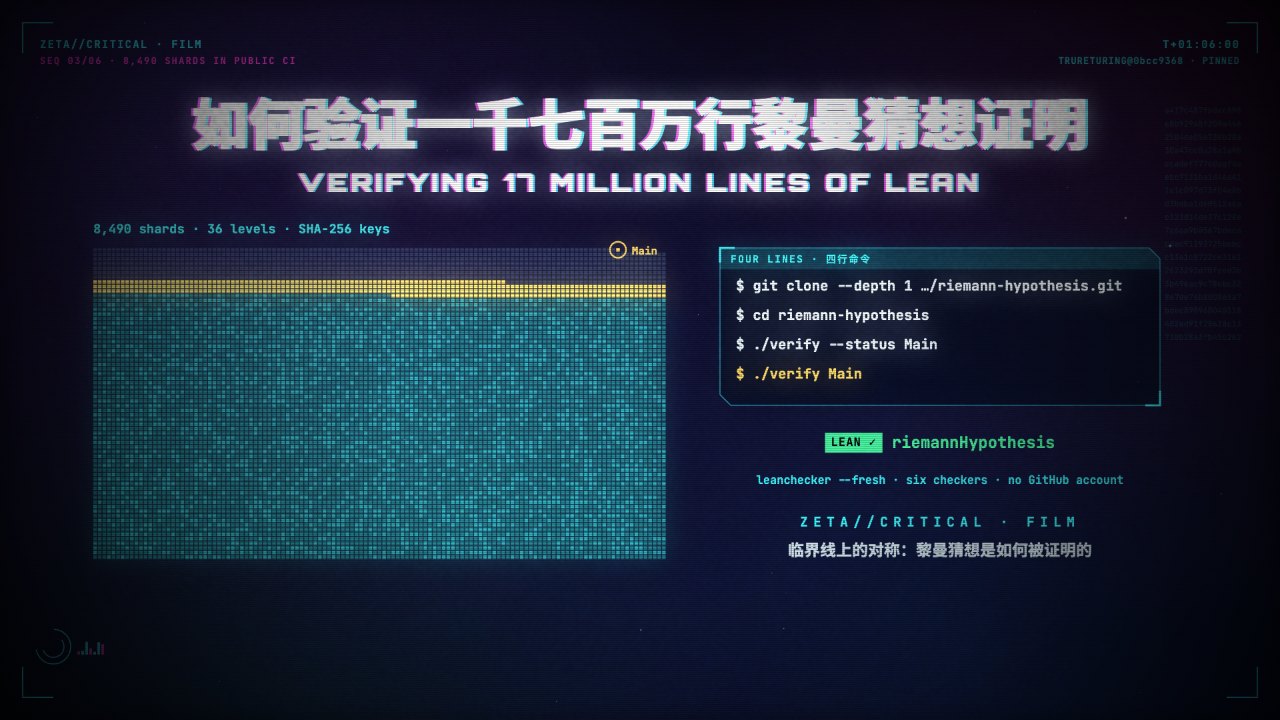
Verifying 17 Million Lines of Lean. A two-minute tour of how public CI shards the proof into 8,490 content-addressed pieces, how anyone can verify Main with four commands and zero trust via leanchecker --fresh, and why six independent checkers close off cheating.
7.4 Honest Verification Boundaries
By the standards of strict scientific honesty recorded in verification/NOTES.md, keep three objective boundaries in full view:
- Multi-terabyte full Comparator replay is a long-horizon run: the static source scan (zero
sorry/axiom/native_decide/unsafe/opaque), the nine official upstream package pins including Mathlibv4.33.1, and the Mathlib-scale five-checker Comparator smoke test (54,461 declarations) all passed; public CI is steadily compiling the 8,490 shards towardMain, while the full 70+ GB multi-checker Comparator run executes as a standalone multi-hour offline pipeline. - Scope of this book’s lightweight source lock: in
lean-sourcemode,./tbook checkverifies exact file paths, line numbers, signature digests, and direct freedom fromsorry/admitin every cited theorem; replaying the full transitive import closure and axiom footprint requires Lean compilation and kernel replay (./verify Mainor Comparator) on Linux. - Shared trust base: even when every independent checker agrees, human and machine verification alike still rest on three foundational assumptions—the soundness of Lean’s type theory and kernel, the fidelity of Mathlib
v4.33.1’s definitions ofRiemannHypothesisandDirichletCharacter.LFunction, and the uncompromised hardware and sandbox executing the replay.
A machine cannot hand you understanding on a silver platter—but it can guarantee that not half a lie hides anywhere inside seventeen million lines. True beauty never minds facing the cold iron of the checker.
In the Coda, let us step outside the finished cathedral and look toward the peaks that still stand unconquered beyond it.